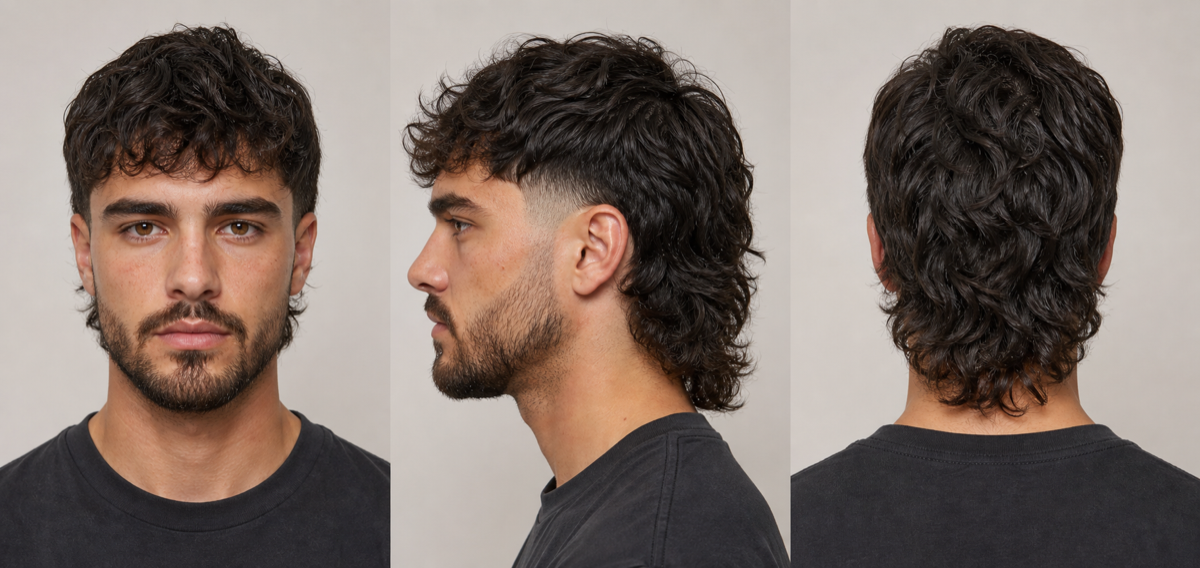
What defines a burst fade mullet?
The fade arcs around the ear and stops before it erases the longer strip through the back. From the side, the blend should look circular; from the rear, the mullet length should remain intentional and connected to the top.
Hair types and proportions to consider
Wavy, curly and dense hair naturally show movement through the back, while straight hair usually needs point-cut texture to avoid a heavy shelf. The style is a bold silhouette rather than a universal face-shape rule, so preview the side and rear proportions before committing.
The editor opens with Burst Fade Mullet selected and keeps your photo in your browser.
The shape that makes it a burst fade mullet
The fade should arc around the ear while leaving a connected strip of length through the back. Removing too much behind the ear turns it into a conventional fade rather than a mullet silhouette.
Burst fade mullet vs a broader mullet fade
A burst fade mullet concentrates the shortest section in a rounded arc around the ear. A broader mullet fade carries the blend farther across the sides. Both keep rear length, but the burst version preserves more hair immediately behind the ear.
Length and texture choices
Wavy and curly hair can keep natural movement through the back. Straighter hair usually benefits from point-cut texture so the longer section does not look heavy or disconnected.
Burst fade mullet variations
A short modern version keeps only a small amount of rear length; a curly version relies on natural volume and shrinkage; and a longer mullet creates a more dramatic side profile. The burst can begin at skin, zero or a soft shadow without changing the core rounded shape.
Burst Fade Mullet from front, side and back
Use all three angles with your barber. The side shows transition height, the back shows the blend path and neckline, and the front shows how the top frames the face.
Ad placement
What to ask your barber
Ask for a rounded burst fade around the ear, skin or your chosen shortest guard at the base, and a connected strip of length through the back. Specify how long the tail should remain and whether the neckline should stay natural, tapered or lightly shaped.
Maintenance and styling
Refresh the burst outline about every two to three weeks if you want the ear arc crisp, while trimming the top and back less often. Use curl cream for natural texture or a light matte paste on straighter hair.
Preview it before the barber
The MensFade editor opens with this style selected. Adjust its position and scale on your photo, compare it with the original, then save a barber instruction card.
Try the Burst Fade Mullet on Your PhotoFrequently asked questions
What makes a burst fade mullet different from a mullet fade?
A burst fade is specifically rounded around the ear and preserves length behind it. A broader mullet fade may carry the blend farther across the sides and back.
How long should the back of a burst fade mullet be?
There is no fixed length. Keep enough to create a visible rear silhouette, then choose a shorter modern finish or a longer, more traditional tail.
Does a burst fade mullet work with straight hair?
It can. Straight hair usually benefits from point-cut or razor texture through the back so the longer section moves instead of looking blocky.